My Teeth Are Shifting.
When you lose a tooth, the rest of your mouth starts to change. It happens slowly, and it does not stop on its own. Dr. Allison House maps the cascade and builds a plan that holds.
When you lose a tooth, the rest of your mouth starts to change. It happens slowly, and it does not stop on its own. Dr. Allison House maps the cascade and builds a plan that holds.
Teeth work as a connected system. When one is missing, the rest start to compensate, and the bite changes over time in quiet ways most patients barely notice. It can show up in a wide range of ways, including these.
If any of these sound familiar, Dr. House can help you stop the cascade before it goes further.
Shifting after tooth loss is not random. It is a predictable chain reaction that starts the moment a tooth is gone and an empty space is left in the arch. Neighboring teeth tip. The opposing tooth drifts. The bite redistributes. Other teeth take on loads they were never built for.
At House Dental in Arcadia, Phoenix, Dr. Allison House evaluates where the cascade started, how far it has gone, and what is still at risk. Every patient arrives at a different stage of the same process, which is why the plan has to match where you are right now.
Conventional care often focuses on symptom control. Our approach identifies and addresses the underlying biological patterns driving the condition.
A missing tooth leaves nothing to stop neighboring teeth from drifting in or the opposing tooth from growing down. The longer the space sits empty, the further the movement travels.
Bone starts shrinking almost immediately under a missing tooth. That loss of height changes how the surrounding teeth sit and how well future implants can be placed.
Teeth on either side of the gap lean inward. Once tipped, they contact opposing teeth at the wrong angle and start chipping, wearing, and loosening over time.
The tooth above or below the gap grows until it finds something to hit. When it finally contacts, it often strikes with off-axis force that damages whatever it lands on.
The mouth learns to chew around the gap. That new pattern overloads specific teeth and the jaw muscles, which is where headaches and joint pain often start.
Teeth that were straightened years ago are more likely to drift once a supporting tooth is removed. What felt stable at 40 moves faster at 60.
Shifting exposes new surfaces to plaque, and some teeth end up with gum recession or deeper pockets. That weakens their anchorage and accelerates the next round of movement.
As chewing becomes harder, diet narrows toward softer foods. Less varied chewing means less balanced loading, which quietly speeds up shifting in the remaining teeth.
Shifting is a story with a beginning, a middle, and an end. The goal is to find where it started and stop it before it rewrites the whole mouth.
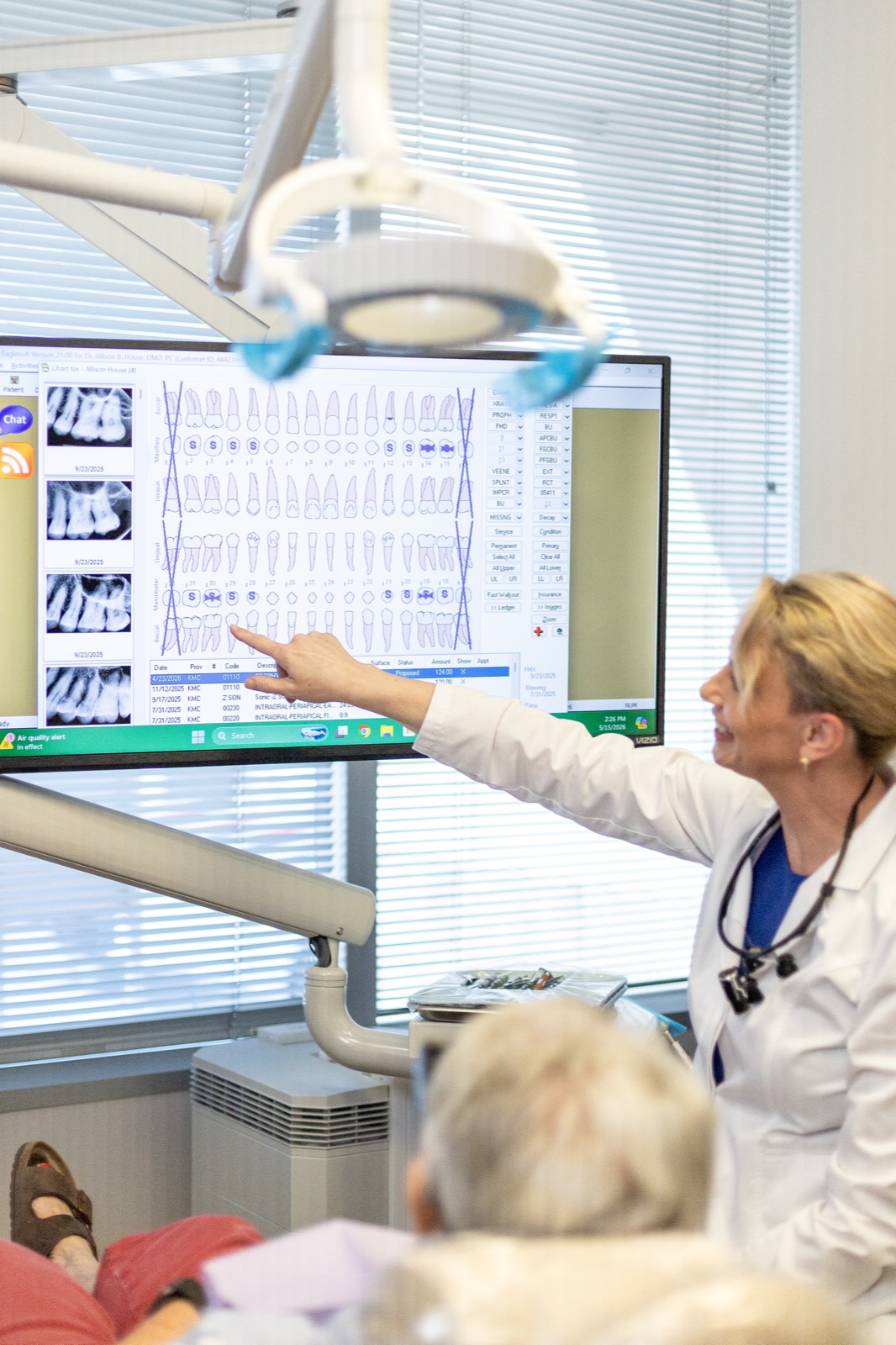
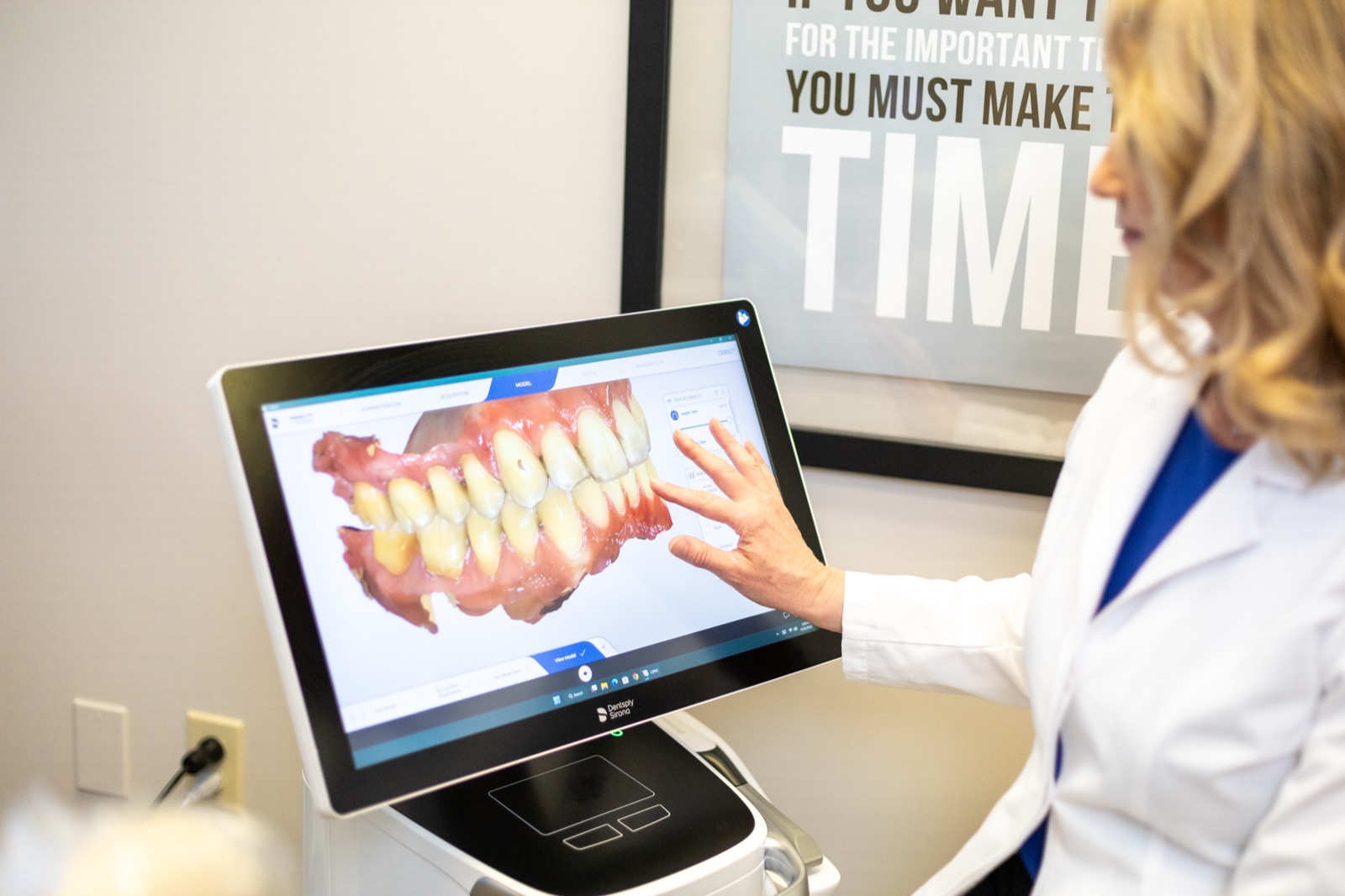
Your first visit is two hours of data collection. Dr. House captures cone beam CT scans, full-series X-rays, digital impressions, and photographs. She reviews your medical history, medications, and diet, because all of these influence how teeth move and what treatments will hold.
She identifies the original missing tooth or teeth, traces which neighbors have tipped, and measures how the bite has redistributed force. She looks at bone density, joint position, and the condition of every tooth, so you can see the cascade in one picture.
Once the full picture is clear, Dr. House builds a staged plan that stabilizes the bite, replaces what is missing, and repositions teeth where needed. It is a group effort. Every phase supports the next so the final result is stable, not just patched.
Every plan is individualized. These are the services most often paired with a diagnostic workup for teeth shifting after tooth loss.
Replacing the missing tooth stops the drift and gives the remaining teeth the support they were built to share. Dr. House plans every implant with cone beam imaging alongside oral surgeon Dr. Becker.
When teeth have already moved, adult orthodontics can guide them back into a healthy position so implants and restorations can be built on a stable foundation.
When the cascade has been in motion for years and multiple teeth need rebuilding, a coordinated reconstruction restores function to the entire arch.
If your question is not here, call us. We would rather talk it through than sell you on a visit.
Shifting can begin within weeks and continues over months and years. Teeth tilt, the bite changes, and force redistributes. The longer a gap goes unreplaced, the more involved the eventual correction.
You can, but the shifting keeps going. What starts as one missing tooth often becomes broken fillings, cracked crowns, and jaw strain over the next several years. Earlier replacement usually means a smaller plan.
It is almost never too late. Dr. House regularly treats patients whose teeth have been drifting for years. Treatment may involve moving teeth back into position, replacing what is missing, and rebuilding what has been damaged.
Your first visit is two hours. Dr. House collects imaging, digital scans, and a full health history. She evaluates how your teeth have moved, how your bite has changed, and what your options are. You leave with a clear picture and a path forward.
A two-hour first visit gives Dr. House the time to trace where the movement started and map what it will take to hold the rest in place. No rushed exam. No guessing.